


It was released in 2003, Kim’s film reflects man’s interactions on nature and nature’s instincts in a mirror, capturing the viewer with a higher sense of life and a broader worldview.
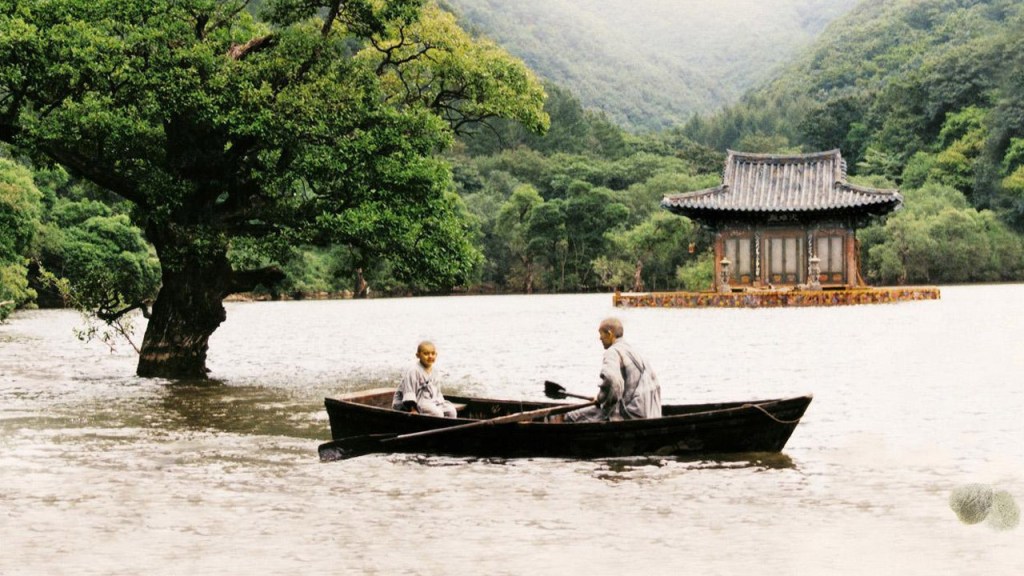
The filmmaker’s background is a river that flows like a deep symbol of life surrounded by a lush green forest and the ……. of an old man in the middle of the river. The Guru is accompanied by a young disciple who begins to learn the lessons of the children by playing with the living beings around the monastery.
Waterfowl, frogs and snakes are toys in front of the boy who goes into the forest in search of curiosities. He binds those beautiful lives with a string.
As punishment for the master who scrutinise the successor, he is tied with a giant stone on his back and sent back, advising him to free the mute creatures. ‘If those lives are ruined by your deeds, you will carry that burden till death’. He says.
By the time the disciple found them, the fish and the snake were already dead. The meaning of the simple life problem touches the audience like a lightning bolt when he cries with his liver split in the recognition given in the first lesson.!
In the second part of the movie, spring turns into summer. The child has now grown into a teenager. Mating snakes and water sports flamingos fill him with sexual thoughts. A natural transition from nature.
He falls in love and has sex with a young woman who is undergoing psychiatric treatment at the monastery. Eventually he leaves the monastery and runs after her. Eventually he becomes a murderer and returns to the monastery.
The Guru calms him down with his magical touch, leaving him on the verge of insanity with guilt. He is soon arrested and imprisoned.
The chariot of time moves again. At the height of the winter, when the river turned into an iceberg, by the time the young man returned to seek guidance after his sentence, the master had finished his work and was burning in a self-made pile. The moment when the audience’s breath stops in the course of life in the infinite flow of time! The young man, who has become a sattvik after the steps of intense experiences, wholeheartedly takes up the silent mission of the Guru.
At the end of a gloomy day, a mother leaves her uncle with her horseradish in the ashram and hides in the heart of the river, as if by some mission. This orphan boy begins to languish in the ashram with the young monk who has made ‘sanniyasa’ a way of life!
A cycle is nearing completion. Frustrated with the burden of work, once again searched for his playmates as he climbed the mountain. The arrival of another spring!
This is the movie. This film, a separate chapter in Kim’s biography as a filmmaker, subtly marks the seasons in human nature. The director has grown to the highest values of humanity by abandoning his preconceived notions of violence and sexuality in this rare work.
The forest and the water surface are intertwined with various living creatures such as fish, flamingos, turtles, chickens, cats, frogs, snakes and green horses. Filling problems.
Beyond all techniques, the film, like any other work of art, becomes a revelation of holistic life.
The philosophical beauty of this film, which embodies the simple sweetness of a screenplay, is that each audience experiences the diverse experiences that the narrator goes through from childhood to old age as a mirror to his own life.
At the end of the picture, the classic sequence of the monk climbing the mountain with the Buddha statue symbolises the human condition with all its conflicts.
Each of the frames in the film is a new interpretation of the art, music and visual language of cinematography. The director cordially invites us to look at life from his own perspective.
In this sense, cinema is not a storytelling or a dramatic scene or a scene, but a vision of the artist’s life. This spring in Korean cinema is becoming a perfect example of this innovative idea.
 The Mockingbird